
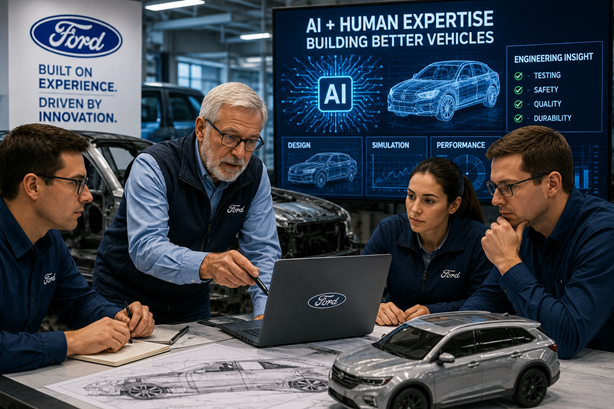
Ford Motor Company is turning back to experienced engineers after discovering that artificial intelligence alone cannot fully replace decades of human expertise in automotive design and manufacturing.
The automaker recently acknowledged that its heavy reliance on AI-driven development processes did not consistently deliver the level of quality and precision required for modern vehicle production. As a result, Ford has begun bringing back seasoned engineers—often referred to as “gray beard” engineers—to help bridge critical knowledge gaps and improve product quality.
The move highlights an important lesson for companies across industries: while AI can accelerate workflows and automate repetitive tasks, human experience remains essential for solving complex real-world problems.
Why Ford Is Bringing Back Experienced Engineers
For years, Ford invested heavily in digital transformation initiatives, including artificial intelligence, machine learning, and automation technologies designed to streamline vehicle development.
However, company executives recently admitted that AI systems struggled to replicate the deep institutional knowledge possessed by veteran engineers.
According to Ford leadership, the company mistakenly believed that simply introducing AI technologies would automatically lead to higher-quality products. Instead, the results demonstrated that engineering judgment, hands-on experience, and practical problem-solving skills remain difficult to automate.
Many veteran engineers possess decades of experience working on vehicle systems, safety testing, manufacturing challenges, and customer feedback analysis—knowledge that AI models often lack.
The Limits of Artificial Intelligence in Engineering
Artificial intelligence has transformed many industries by improving efficiency, reducing costs, and accelerating decision-making processes.
In engineering environments, AI can assist with:
- Data analysis
- Design simulations
- Predictive maintenance
- Manufacturing optimization
- Quality control monitoring
Despite these advantages, AI still faces significant limitations.
Engineering projects often involve unique situations, unexpected variables, and practical challenges that require human judgment. Experienced professionals can identify potential risks, understand historical design failures, and make informed decisions based on years of industry knowledge.
Ford’s experience demonstrates that AI performs best when it supports human expertise rather than replacing it entirely.
Why Veteran Engineers Still Matter
The return of experienced engineers reflects the growing recognition that knowledge accumulated over decades cannot easily be replicated by algorithms.
Veteran professionals contribute:
Deep Technical Expertise
Years of hands-on experience allow engineers to recognize problems before they become costly failures.
Historical Knowledge
Experienced workers understand previous design successes and mistakes, helping teams avoid repeating costly errors.
Mentorship
Senior engineers play a critical role in training younger professionals and transferring institutional knowledge.
Better Decision-Making
Complex engineering challenges often require intuition and practical judgment that extend beyond data-driven recommendations.
A Growing Trend Across Industries
Ford is not alone in reassessing the role of AI.
Many organizations initially believed that artificial intelligence could dramatically reduce dependence on skilled professionals. However, businesses across technology, healthcare, manufacturing, and finance are increasingly adopting a hybrid approach that combines AI tools with human expertise.
Industry leaders are discovering that the most effective strategy is not choosing between AI and humans but leveraging the strengths of both.
AI excels at:
- Processing massive datasets
- Identifying patterns
- Automating repetitive tasks
- Increasing operational efficiency
Humans excel at:
- Critical thinking
- Creativity
- Ethical judgment
- Strategic decision-making
- Problem-solving in uncertain situations
What This Means for the Future of Work
Ford’s decision sends an important message about the future workplace.
While AI will continue transforming industries, skilled professionals remain valuable assets. Companies that invest in both technology and human talent are likely to achieve better long-term outcomes than those relying exclusively on automation.
The future workforce will increasingly require employees who can collaborate with AI systems rather than compete against them.
Professionals who combine industry expertise with AI literacy may become some of the most sought-after workers in the coming years.
Lessons Businesses Can Learn from Ford
Ford’s experience offers several important lessons for organizations implementing AI technologies:
- AI should complement human expertise rather than replace it.
- Institutional knowledge remains a critical business asset.
- Experienced professionals provide value beyond technical skills.
- Automation strategies should be carefully tested before large-scale implementation.
- Long-term success often depends on balancing innovation with practical experience.
Companies that ignore these lessons may encounter similar challenges when attempting to automate complex processes.
The Road Ahead
Artificial intelligence will undoubtedly continue playing a larger role in product development and business operations. However, Ford’s decision to rehire veteran engineers demonstrates that experience, wisdom, and human judgment remain irreplaceable in many areas.
Rather than viewing AI as a replacement for skilled workers, organizations may achieve better results by creating collaborative environments where technology enhances human capabilities.
As businesses continue navigating the AI era, Ford’s experience serves as a reminder that the most advanced technology still benefits from the guidance of experienced professionals.
Related Articles
- How AI Is Reshaping the Automotive Industry
- Top AI Tools Transforming Manufacturing in 2026
- Why Human Expertise Still Matters in the Age of Automation
- The Future of Artificial Intelligence in Engineering
- How Automakers Are Using AI to Improve Vehicle Safety
- AI vs Human Creativity: Can Machines Truly Replace Experts?
- Emerging Technology Trends Every Business Should Watch
- The Growing Demand for Skilled Tech Professionals in an AI World
Conclusion
Ford’s decision to bring back experienced “gray beard” engineers highlights a growing realization across industries: artificial intelligence is powerful, but it is not a complete substitute for human expertise. The future of innovation lies not in replacing people with AI but in combining technological advancement with the wisdom and experience of skilled professionals.